Introduction
AI Agents vs Chatbots is becoming an important topic as artificial intelligence continues to change how we study, work, create content, and complete everyday tasks. I often see these two terms used interchangeably, but they are not exactly the same. Understanding the difference can help you choose the right AI tool.
For students, content creators, freelancers, and everyday AI users, knowing when to use an AI chatbot and when to use an AI agent can save time and improve productivity. So, let’s understand the difference in simple language.
What Is an AI Chatbot?
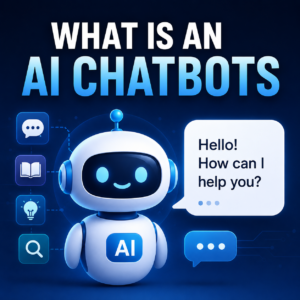
An AI chatbot is an AI-powered tool designed mainly to communicate with users. I can ask it questions, request explanations, generate ideas, summarize information, or get help with different tasks.
For example, I can ask a chatbot to explain a difficult programming concept in simple language. It can provide an answer immediately, but I usually need to give another instruction when I want it to perform the next task.
How Do AI Chatbots Work?
Most chatbots follow a simple interaction: I give an instruction, the chatbot processes it, and then provides a response.
Modern AI chatbots can understand natural language and handle more flexible conversations than traditional rule-based bots. However, their main purpose remains conversation and assistance.
What Is an AI Agent?
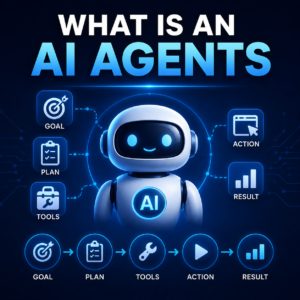
An AI agent is designed to do more than simply respond to a message. It can work toward a specific goal by planning steps, using available tools, making decisions, and completing multiple actions.
For example, instead of asking an AI chatbot to research a topic one step at a time, I could give an AI agent a broader goal such as researching a subject, organizing information, and preparing a structured report.
How Do AI Agents Work?
An AI agent can follow a process such as understanding a goal → planning → using tools → taking action → checking the result.
This ability makes AI agents useful for complex and repetitive workflows. The exact capabilities depend on how the agent is designed and what tools or systems it can access.
AI Agents vs Chatbots: Key Differences
The easiest way I explain AI Agents vs Chatbots is this: a chatbot mainly gives me a response, while an AI agent can work toward completing a goal.
| Feature | AI Chatbots | AI Agents |
|---|---|---|
| Main purpose | Conversation and answers | Completing goals and tasks |
| Autonomy | Usually lower | Usually higher |
| Planning | Limited | Can handle multiple steps |
| Tool usage | May be available | Often central to the workflow |
| Best for | Questions and assistance | Automation and complex tasks |
| Human input | Often needed for each step | Can require less step-by-step input |
AI agents can reason through a goal, use connected tools, and manage multi-step workflows, while chatbots are generally focused on conversational assistance.
AI Agents vs Chatbots for Students
For students, AI Agents vs Chatbots is not really about choosing which technology is better. I would choose based on the task I need to complete.
If I want help understanding a lesson, creating study notes, generating practice questions, brainstorming project ideas, or learning programming, an AI chatbot can be extremely useful.
If I want to automate a longer process involving multiple steps or tools, an AI agent may be more suitable.
Best Uses of AI Chatbots for Students
I can use AI chatbots for:
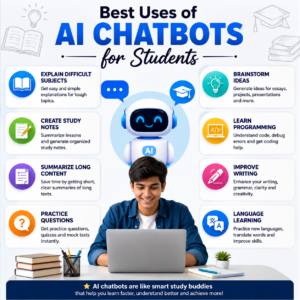
- Explaining difficult subjects
- Creating study notes
- Summarizing long content
- Practicing interview questions
- Learning programming concepts
- Brainstorming project ideas
- Improving writing
These tasks usually require interaction and guidance rather than complete automation.
Best Uses of AI Agents for Students
AI agents can be useful when a task involves several connected steps. For example, an agent could potentially help organize research, process information, or manage parts of a repetitive workflow.
However, I would always review AI-generated information, especially when using it for academic research or important assignments.
AI Agents vs Chatbots for Content Creators
Content creators can also benefit from understanding AI Agents vs Chatbots.
I would use an AI chatbot for brainstorming video ideas, writing captions, creating outlines, improving scripts, or generating content variations.
An AI agent becomes more useful when I want to automate a workflow involving multiple steps, such as organizing research, processing information, or moving data between connected tools.
Which One Should You Choose?
The right choice depends on what I want AI to accomplish.
If my main goal is asking questions, learning, brainstorming, writing, or getting quick assistance, I would start with an AI chatbot.
If my goal is automating a multi-step process, using external tools, and completing tasks with less step-by-step guidance, I would consider an AI agent.
In many cases, these technologies can also work together rather than being direct competitors.
Will AI Agents Replace Chatbots?
I don’t think AI agents will completely replace chatbots. Instead, I see them as different approaches to using AI.
Chatbots are excellent for communication and quick assistance, while AI agents are designed for more action-oriented workflows. As AI technology develops, some tools may combine a chatbot-style interface with agent-like capabilities.
Conclusion
After understanding AI Agents vs Chatbots, I think the simplest way to remember the difference is: chatbots are mainly conversation-focused, while AI agents are more goal- and action-focused.
For students and content creators, chatbots can be excellent learning and creative partners. AI agents can become powerful productivity tools when a task requires multiple steps, tools, or automation.
The important thing is not to choose the most advanced AI tool, but to choose the one that actually solves my problem.
If you could have one AI assistant for your daily work or studies, would you choose an AI chatbot or an AI agent—and what would you ask it to do?